 ESPEC North America, Inc. (Corporate office)
4141 Central Parkway
Hudsonville, MI 49426 USA ESPEC North America, Inc. (Colorado/Qualmark office)
12600 E. Smith Road
Aurora, CO 80011 USA
303-254-8800

Thursday, October 08 2026
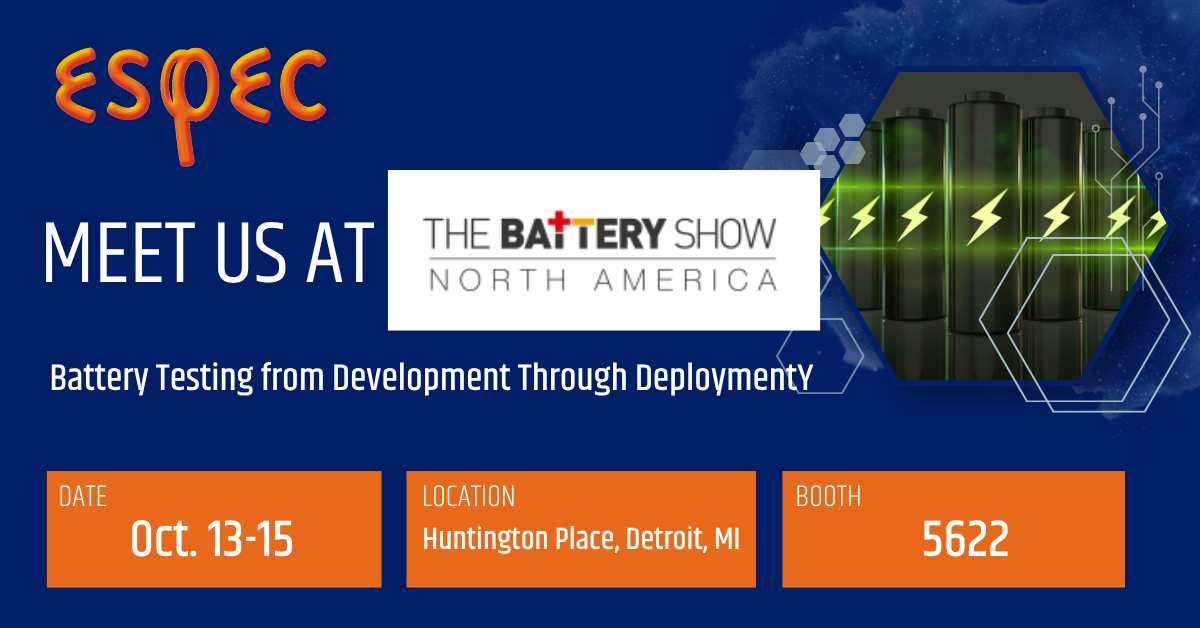
If you're working on lithium-ion cells, battery pack integration, stationary energy storage, or power supply validation, you already know how quickly testing requirements outpace the equipment you have in place. The Battery Show North America is where the industry gathers to close that gap. We'll be at Huntington Place in booth 5622 with two battery test chambers and a technical team ready for a real conversation about your program.
Event Details
Event: The Battery Show North America 2026
Expo Dates: October 13-15, 2026
Venue: Huntington Place, 1 Washington Boulevard, Detroit, MI 48226
ESPEC booth: 5622
Floor time fills up fast at an event this size. Reach out ahead of time and we'll set aside dedicated time for you, so we're not just catching each other mid-aisle.
Two chambers anchor our booth. The ADBC Advanced Battery Test Chamber is built specifically for charge and discharge testing in a compact footprint. The Platinous EPU-3 is configured with enhanced safety features for demanding battery testing applications.
The ADBC is our purpose-built, three-zone temperature chamber for charge and discharge testing of lithium-ion and other advanced battery types. It runs from minus 40 degrees C to plus 100 degrees C, with uniformity of plus or minus 1.5 degrees C.
It reaches plus 100 degrees C from plus 20 degrees C within 60 minutes, and minus 30 degrees C from plus 20 degrees C in the same window. Three separately controlled chambers, each with independent cooling, sit in one unit. Horizontal laminar airflow keeps temperature uniform across the test space.
The integrated design accommodates the charge and discharge power supply you prefer. You choose the equipment that fits your program and budget, and the chamber is built around it.
Lab space usually comes at a premium, and that's where the ADBC makes its case. You get fewer square feet, one installation, and one support relationship. For teams building new battery test capability or consolidating aging setups, the footprint argument is real.
Standard safety features include screw-in door locks and an emergency stop switch. Options include H₂ and CO gas detectors, heat and smoke detectors, pressure relief vents, CO₂ fire extinguishing, forced-air ventilation with exhaust dampers, and seismic bracing.
See full specifications on our battery test chambers product page.
Platinous is our most popular general-use reach-in series, and we've built it in the USA since 1989. The unit on our floor takes that proven platform and configures it for one of the most demanding jobs in environmental testing.
Physical protection starts at the door, with a reinforced door latch and a solenoid-activated door lock. A pressure-relief blow-out port, a spark-resistant interior with sheathed heaters, and cable port restraints round out the hardware.
An integrated safety system adds H₂ and CO gas monitoring, fire detection with automatic chamber shutdown, CO₂ fire suppression, and chamber ventilation. Together, they provide multiple layers of protection designed to help address the potential hazards associated with battery testing.
Configuration varies by model and application. Tell us what you're testing and we'll walk through what fits.
Our battery testing brochure covers the full safety and protection option list.
The difference between data that satisfies a regulatory review and data that gets questioned is almost always traceability. Thermal runaway events, capacity degradation curves, and safety failure thresholds mean nothing in an audit if the test conditions can't be verified.
When batteries aren't properly characterized under the conditions they'll actually see, safety failures show up in the field instead of the lab. Problems found in the lab are solvable. Problems found after delivery are expensive.
Our quality management system is certified to ISO 9001:2015, covering our Hudsonville, Michigan and Aurora, Colorado locations. Our calibration is accredited to ISO/IEC 17025:2017, so the data your chambers produce traces back to an accredited standard, not just internal records. For engineers working to UN 38.3 and IEC and UL battery safety standards, that's what makes a qualification package defensible.
Learn more about battery test methods and specifications and review our battery safety resources before the show.
Energy storage isn't a single customer profile. You might be validating cells for a stationary grid application, qualifying a pack for an industrial power supply, or running accelerated aging on a module headed for commercial building backup.
The requirements differ, but they share a problem. Batteries encounter a wide range of thermal, electrical, and mechanical conditions over their service life, and programs that only simulate peak conditions leave gaps.
That kind of program also needs equipment that stays running. Downtime mid-program doesn't just delay results. It can compromise a test series that depends on consistent conditions across thousands of cycles.
Our support model is built around that constraint. It includes installation planning, training, Chamber Care preventative maintenance, ISO/IEC 17025 calibration, and responsive field service. For a deeper look at methodology across battery applications, our battery testing FAQ covers the practical details.
We'll be at booth 5622 at Huntington Place, October 13-15. Our headquarters and manufacturing are in Hudsonville, so this is a home show for us. We're part of the Michigan battery and automotive supply chain community, not just visiting it.
If you want time with a technical expert instead of a booth pass-by, schedule a conversation before the show opens. You can also request spec sheets ahead of time so your technical review happens before you arrive.
Our job is to make reliability testable, and that applies to every battery chemistry, every standard, and every stage of your program.
Schedule a meeting or request more information → [email protected]
Not attending but interested in the ADBC or ESPEC's battery testing solutions? Contact our team directly → [email protected]
ESPEC North America, Inc. (Corporate office)