 ESPEC North America, Inc. (Corporate office)
4141 Central Parkway
Hudsonville, MI 49426 USA ESPEC North America, Inc. (Colorado/Qualmark office)
12600 E. Smith Road
Aurora, CO 80011 USA
303-254-8800

Tuesday, September 22 2026
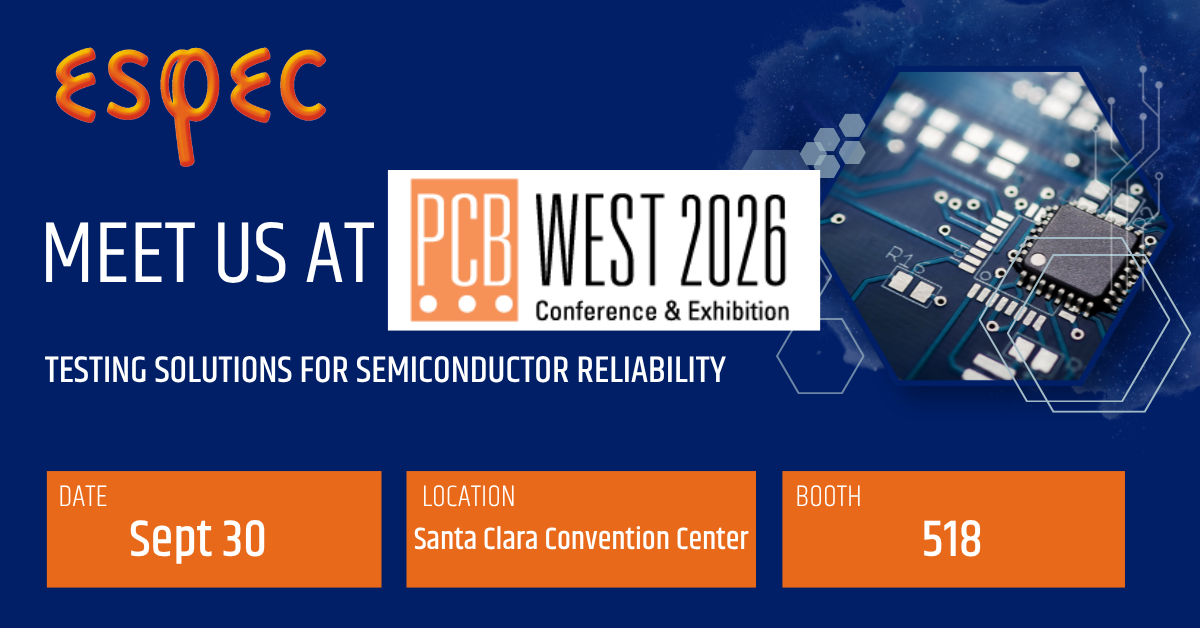
PCB West has spent more than 30 years training designers, engineers, fabricators, and assemblers, and it's the largest conference and exhibition for printed circuit board design, fabrication, and assembly in Silicon Valley. More than 2,000 people register each year and over 100 companies exhibit, across a four-day technical conference and a single exhibition day. We're there this year to put our semiconductor reliability portfolio in front of that audience directly.
Semiconductor manufacturing is moving back to North America. The engineers designing and building the boards behind that expansion need test methods that catch failure modes standard functional testing misses, and that's the conversation we're coming to have.
Three things are converging to make reliability testing harder to get right.
Boards keep getting denser. Conductor spacing has tightened to the point where electrochemical migration is no longer a rare edge case, and it rarely shows up on a functional test. It shows up in the field, under conditions the bench never replicated.
At the same time, electronics are moving into automotive, industrial, and high-reliability environments with thermal cycling demands that consumer applications never imposed. Solder joints and conductors cycle through extremes for the life of the product, and the resulting failures are often intermittent, which makes them expensive to diagnose after shipment.
Then there's the knowledge gap. Tenured engineers who spent careers building deep expertise in failure mechanisms like ECM and joint degradation are retiring, and the engineers coming up behind them have had less exposure to it. ESPEC and Hobbs Engineering are working to close that gap through training and consultation, and PCB West is a direct path to the engineers who need it.
Electrochemical migration is the movement of conductive material through or across an insulator under applied voltage and humidity. Catching it means watching for both gradual resistance drift and sudden migration events, which is exactly what the AMI electrochemical migration evaluation system is built to do.
Event detection runs at speeds under 100 microseconds, so transient failures don't slip through unrecorded. The system supports up to 300 channels with independent module control, with a standard testing voltage of 100V and options up to 2,500V. It's built to comply with IPC-TM-650 (2.6.3.3), AEC-Q200, and ISO/IEC 17025.
AMI pairs natively with our HAST chambers, which combine high temperature, elevated humidity, and positive pressure to accelerate moisture-related failure mechanisms. Running AMI inside a HAST chamber synchronizes the electrical measurements with the environmental conditions in a single test run. That's one picture of what's happening to the board, not two data streams to correlate afterward.
The AMR conductor resistance evaluation system provides continuous, high-precision monitoring of solder joint and conductor resistance during thermal cycling. Accuracy is plus or minus 0.5% at 100mOhm, the system scales from 40 to 280 channels, and every unit ships with ISO/IEC 17025-compliant calibration.
AMR links directly with the TSE-12 thermal shock chamber, correlating resistance data with temperature transitions as they happen. The result is a continuous record of how joints and conductors behave across thousands of cycles instead of a pass or fail at the end of the run.
AMI pairs with the HAST chamber. AMR pairs with the thermal shock or temperature and humidity chamber. Both systems are engineered by ESPEC to work with ESPEC chambers, so this isn't a combination of third-party components stitched together after the fact.
When the chamber and the measurement system come from the same engineering team, timing, data output, and calibration are coordinated from the start. Test runs produce synchronized data, setup gets simpler, and there's one point of contact when something needs attention.
ESPEC North America is part of ESPEC Corp., the world's largest company dedicated exclusively to environmental test chambers. We hold ISO 9001:2015 manufacturing certification, every AMR unit ships with ISO/IEC 17025-compliant calibration, and AMI supports IPC-TM-650 (2.6.3.3), AEC-Q200, and ISO/IEC 17025.
The AMI and AMR line originates from ESPEC's Japanese engineering organization. It's a mature portfolio, and we're bringing it to North American labs as a growth initiative.
If you're responsible for reliability testing, qualification, or test equipment selection on dense PCBs, we want to connect. Our team includes engineers trained directly in Japan on the AMI and AMR systems, so the conversation at our booth happens at the application level, not the brochure level.
Whether you're evaluating ECM detection methods, working through a thermal cycling program, or figuring out how these systems would fit your existing lab workflow, we're ready to dig in.
The exhibition floor runs one day only, and PCEA reports it sells out. With 2,000-plus attendees moving through in a single session, a walk-by gets you an overview. A scheduled meeting gets your questions answered before the floor fills up.
Reach out before September 30 to reserve time with our team, or call us at 616-896-6100 to talk through your requirements ahead of the show. You can also explore our AMI and AMR electronic reliability systems online before you arrive.
Make reliability testable.
ESPEC North America, Inc. (Corporate office)