 ESPEC North America, Inc. (Corporate office)
4141 Central Parkway
Hudsonville, MI 49426 USA ESPEC North America, Inc. (Colorado/Qualmark office)
12600 E. Smith Road
Aurora, CO 80011 USA
303-254-8800

Wednesday, July 22 2026
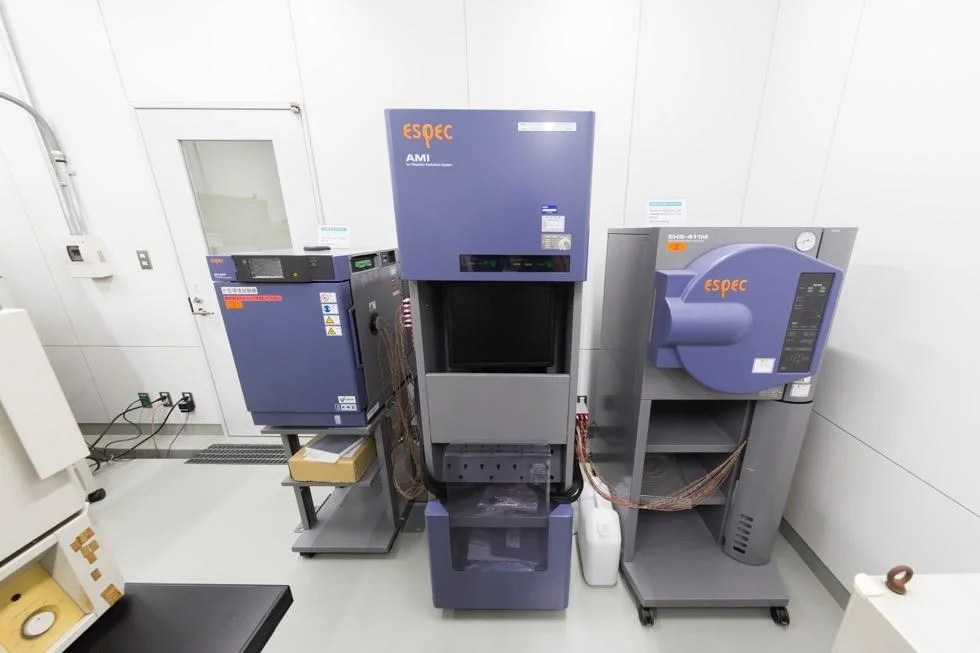
Reliability in modern electronics is not achieved by hoping products hold up in the field. It is built by understanding how and why they fail, then creating the conditions to observe those failures under controlled, repeatable circumstances, before a single unit reaches the field.
Electrochemical migration (ECM), insulation resistance degradation, and solder joint failures are three of the most persistent and destructive reliability threats in electronics today. What makes them particularly difficult is that they often appear intermittently, only under specific combinations of humidity, temperature, and applied voltage. Standard functional tests miss them. Visual inspections miss them. And by the time they surface in the field, the cost is no longer just technical.
Our AMI and AMR systems are designed to make these failure mechanisms visible, measurable, and reproducible.
Engineered as a unified system with ESPEC environmental chambers, they give your team the data clarity to find problems early, validate fixes with confidence, and meet the traceability requirements your customers and auditors demand.
As electronics become smaller and denser, the conditions for failure concentrate. Conductor spacing once measured in millimeters is now measured in microns. Under elevated humidity and applied electrical bias, even trace contamination can provide the ionic pathway needed to initiate migration and the distance a dendrite must bridge to cause a short has never been smaller.
What makes these failures so difficult to catch is their behavior. A dendrite may form overnight and partially dissolve by morning when conditions normalize. The circuit tests clean. The root cause stays invisible until the product is in the field and the cost is no longer just technical.
Insulation resistance degradation follows a different but equally frustrating pattern. Resistance drifts downward gradually as contamination, moisture, and thermal stress interact over time. By the point a standard functional test registers the anomaly, the damage is often already done.
Standard periodic testing was not designed to catch either failure mode. Doing so requires continuous monitoring, sufficient channel density, and measurement speed fast enough to detect events that resolve in milliseconds. That is the specific capability gap the AMI and AMR systems were developed to close.
ECM in electronics describes the movement of metal ions under an applied electric field, through a moisture film that forms on or between conductive surfaces. The mechanism unfolds in three stages that are well-established but frequently underestimated in their combined severity.
At the anode, metal oxidizes and dissolves into solution. Common susceptible metals include copper, silver, tin, and lead. Those ions migrate through the moisture layer toward the cathode, driven by the potential gradient between conductors. At the cathode, they reduce and deposit as solid metal, building a conductive filament that grows progressively back toward the anode. When it bridges the gap, resistance drops to near zero. The result is a short, intermittent at first, then permanent.
The conditions that produce this are not extreme. Humidity above roughly 60 to 70 percent relative humidity is enough to form the moisture film that initiates the process. Voltages as low as a few volts can sustain migration across fine-pitch conductors. Ionic contamination from flux residues, handling, or ambient exposure accelerates it significantly. Higher temperatures increase reaction rates. Tighter geometries shorten the distance a dendrite must travel to cause damage.
Modern high-density electronics carry inherent ECM vulnerability that cannot be designed away entirely. It has to be tested for, under the conditions that actually produce it.
The AMI and AMR systems are complementary, but they are engineered for fundamentally different failure physics. Using one to substitute for the other produces gaps that real-world failures will eventually find.
The AMI system applies electrical bias across insulation structures under controlled temperature and humidity conditions. Its purpose is to detect two distinct behaviors: gradual insulation resistance drift, which trends downward over time as materials degrade, and instantaneous ECM events, which occur in microseconds when a migrating filament bridges a gap. Both behaviors involve high-impedance electrical paths. Both require measurement approaches that prioritize sensitivity and speed.
The AMR system is designed for a different problem entirely. Solder joints, connector contacts, and conductor paths degrade under thermal cycling through fatigue mechanisms that produce incremental resistance increases. Those increases are small, often in the milliohm range, and they evolve over thousands of cycles rather than in a single event. Detecting them requires continuous, high-accuracy resistance monitoring across many test channels simultaneously, with data correlated directly to the environmental conditions applied during cycling.
Insulation resistance failures are not the same as joint resistance failures. Trending is not the same as event capture. Test design must match the failure mode, not just the applicable standard.
Dense electronics present two related but distinct electrical failure risks, and the AMI system is designed to surface both before they reach the field.
The first is ECM, including transient events that appear and resolve rapidly, and sustained migration that leads to permanent conductor bridging. The second is insulation resistance degradation, where materials progressively lose their ability to resist leakage current under combined humidity, temperature, and bias stress.
Both behaviors can occur across many test samples simultaneously in a qualification or production environment. Both demand measurement infrastructure capable of covering that scale without sacrificing resolution or speed.
IPC-TM-650 (2.6.3.3) provides the industry-standard framework for insulation resistance and ECM testing. AMI system capabilities are designed to support that standard while also providing the speed and channel density that production qualification demands.
For advanced microscopic wiring electromigration evaluation at elevated temperatures, ESPEC also offers the AEM system as part of its broader semiconductor reliability portfolio. AMI and AEM address adjacent but distinct failure mechanisms and can be applied in combination where both phenomena are relevant to the design under evaluation.
Solder joint and connector failures under thermal cycling are among the most common root causes of electronics field returns across automotive, aerospace, and high-density board applications. By the time those failures are visible, the cost is already significant. The AMR system is designed to detect them before it is too late to act.
Joint resistance degradation under thermal stress is cumulative. Fatigue accumulates in solder connections and conductor interfaces with each cycle. Resistance increases incrementally, often too small to register in a single measurement, but clearly progressive when tracked continuously across a long-duration cycling program. The AMR system provides that continuous monitoring, correlating resistance data directly to the environmental conditions applied during testing, so degradation trends are visible as they develop rather than after they cause failures.
ISO/IEC 17025 calibration support for data reliability and traceability.
Most test programs apply environmental stress in one instrument and measure electrical behavior in another. The correlation between those data streams is often reconstructed after the fact, based on timestamps and manual records. That reconstruction introduces uncertainty exactly where precision is most important: at the moment a failure occurs.
ESPEC's AMI and AMR solutions are engineered to operate as a unified testing ecosystem with our environmental chambers. Shared scheduling, synchronized data capture, integrated safety functions, and unified system control eliminate the need to manually correlate environmental conditions with electrical measurements, making it easier to identify when and why failures occur.
When a resistance exceedance or ECM event occurs, the corresponding temperature, humidity, and elapsed test time are recorded simultaneously, in the same system, without manual correlation or post-test reconstruction. Root-cause analysis becomes a matter of reading the data, not rebuilding it.
This is the difference between pairing instruments and building a reliability system. Reliability improves when variables are controlled together, not managed separately. Synchronized environmental and electrical testing is what moves a lab from reactive failure investigation to proactive reliability validation.
For teams operating under regulatory oversight, customer qualification requirements, or internal quality systems, the value of a test system is only as strong as the data it produces. Measurement traceability and calibration documentation are not secondary considerations. They are the foundation of defensible test evidence and the difference between a qualification package that holds up under scrutiny and one that doesn't.
AMI and AMR systems support the standards that matter most in electronics reliability qualification:
Full data logging, graphing, and long-term trend capture across all active channels ensure that the evidence base for a qualification program is complete, organized, and accessible when it needs to be.
For teams that need ongoing calibration and support services beyond initial system deployment, ESPEC provides that continuity as part of the same partnership.
ESPEC's entire organization is dedicated to environmental test chambers and reliability systems. This is not a product line within a broader industrial equipment portfolio. It is our entire focus, and that focus shapes every system we design, every service we provide, and every customer relationship we build.
The AMI and AMR systems are engineered from the ground up to operate as part of the ESPEC chamber ecosystem. Integration is not achieved by pairing third-party instrumentation with our chambers after the fact. It is integrated into the architecture of the systems, providing synchronized control, shared scheduling, unified alarming, and correlated data in a way that assembled configurations cannot replicate.
Our support model extends beyond installation. Training, calibration, preventative maintenance, and responsive technical service are part of how we operate with every customer, because a test system that is miscalibrated, improperly operated, or out of service is not delivering reliability value regardless of its specifications.
Our Solutions Group now has AMI and AMR systems installed and operational in our Aurora, Colorado lab, with expert-trained domestic support for consultation, demonstration, and application guidance. If you are evaluating these systems or working through a specific test program challenge, our team is available to help you move from question to answer quickly.
Explore the advantages of ESPEC systems
Electrochemical migration, insulation resistance degradation, and joint reliability failures are not problems that resolve themselves with more testing time or better documentation. They require the right measurement approach, applied under the right environmental conditions, with the data infrastructure to support whatever decisions come next.
We are ready to help you get there.
Make reliability testable. Start the conversation today.
ESPEC North America, Inc. (Corporate office)