Semiconductors sit at the heart of every modern technology breakthrough — from AI accelerators and high-performance computing to automotive electrification and advanced 3D packaging. As devices shrink, interconnects multiply, and heat loads intensify, the margin for error disappears. Reliability is no longer a late-stage checkbox; it is a competitive advantage.
In the race toward next-generation devices, even microscopic defects can trigger field failures, costly recalls, safety risks, or yield loss. The industry’s rapid transition toward chiplets, heterogeneous integration, 3D stacking, and ultra-fine redistribution layers only elevates this challenge.
That’s why environmental, electrical, and thermal testing must work hand in hand.
Microscopic defects do not always fail immediately. They emerge under stress:
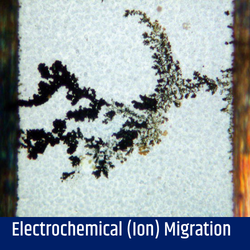
Humidity-driven electrochemical migration in fine redistribution layers
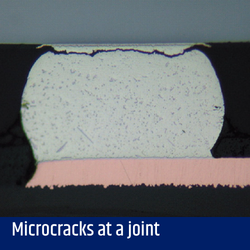
Microcracks in solder joints during rapid temperature transitions
Electromigration wear-out under sustained current density
Interconnect fatigue caused by thermal expansion mismatch
Evaluating these mechanisms independently provides only part of the picture.
Electrical bias without environmental stress does not replicate real-world operating conditions. Environmental stress without live electrical monitoring delays failure detection.
When electrical measurement systems and environmental simulation operate in sync, failure modes become visible earlier and more clearly. Engineers can correlate temperature, humidity, pressure, vibration, and bias conditions directly with electrical degradation in real time.
That integration defines ESPEC’s semiconductor testing platform.
A Coordinated Semiconductor Reliability Ecosystem
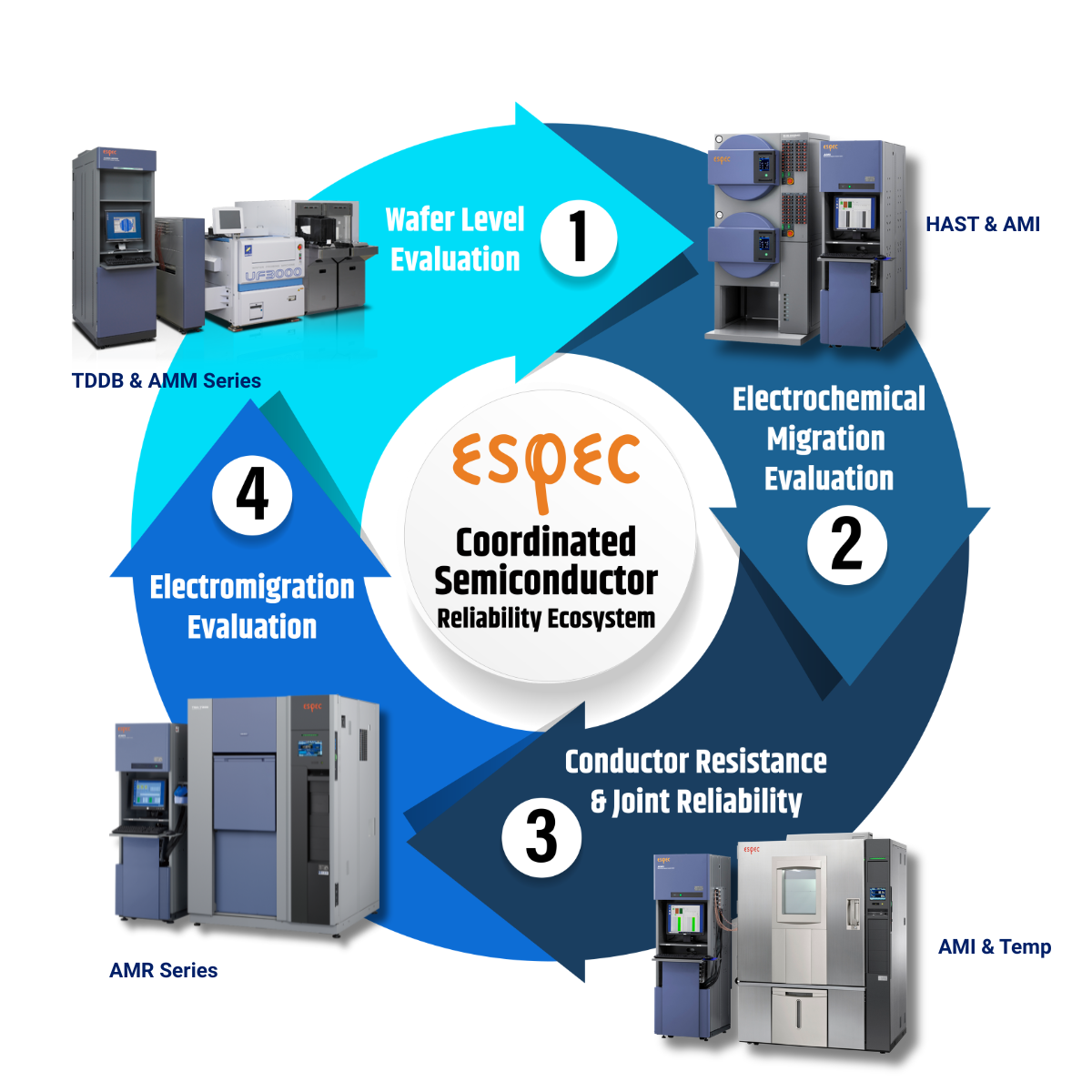
Semiconductor reliability is not built through a single test method. It is achieved through a coordinated evaluation strategy that spans wafer-level characterization, advanced packaging validation, accelerated environmental stress, and real-time electrical monitoring.
ESPEC’s semiconductor portfolio is structured to support this lifecycle — combining electrical evaluation systems with environmental simulation platforms to create a unified, repeatable, and standards-aligned testing environment.
From early defect detection at the wafer level to migration analysis, joint fatigue monitoring, electromigration evaluation, and high-acceleration stress screening, our solutions are engineered to measure how devices behave under real-world conditions — not just nominal ones.
The sections below outline how these systems work together to support modern semiconductor development and qualification.
Wafer-Level Evaluation Systems
Early-stage defect detection reduces downstream yield loss and reliability risk.
ESPEC supports wafer-level characterization and dielectric evaluation through advanced parametric and TDDB systems designed for leading-edge process development. These systems enable:
Detection of dielectric breakdown behavior
Electrical instability analysis at advanced nodes
Process-induced defect identification prior to packaging
Integrated with precision temperature control where required, wafer-level evaluation helps engineering teams stabilize process performance before transitioning to advanced packaging and final qualification.
Electrochemical Migration Evaluation
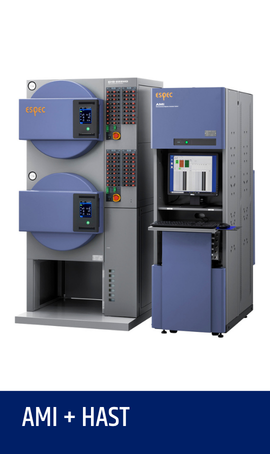
AMI Series + HAST & Temperature-Humidity Platforms
As redistribution layers narrow and substrate density increases, electrochemical migration and insulation degradation become primary reliability risks.
The AMI Series evaluates insulation resistance behavior and captures instantaneous migration events under controlled environmental stress. Key capabilities include:
Multi-channel resistance monitoring
High-speed event detection for transient insulation failure
Configurable bias voltage options
Support for JEITA and JEDEC humidity-bias testing
When paired with:
HAST chambers
Temperature-humidity systems
ENA Platinous environmental platforms
AMI enables synchronized humidity, temperature, and bias application with real-time electrical monitoring.
This integration is critical for evaluating RDL insulation integrity, substrate migration behavior, and long-term package reliability under high-humidity stress conditions.
Conductor Resistance & Joint Reliability
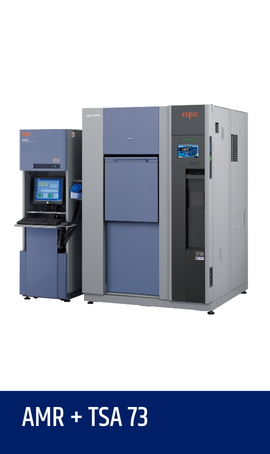
AMR Series + Thermal Shock & Rapid-Rate Thermal Cycling
Advanced packaging architectures introduce mechanical stress between materials with mismatched coefficients of thermal expansion. Under rapid temperature transitions, microcracks can form at solder joints and interconnect interfaces.
The AMR Series continuously measures conductor resistance during accelerated thermal stress, allowing detection of intermittent or transient connection failures.
Core capabilities include:
High-accuracy resistance measurement across multiple channels
Real-time monitoring during temperature transition
Expandable architecture for complex device configurations
AMR correlates resistance fluctuation directly with thermal transition events. This is particularly valuable for FC-BGA, 2.xD / 3D packaging, TSV interconnects, and high-pin-count assemblies subject to aggressive cycling profiles.
Electromigration Evaluation
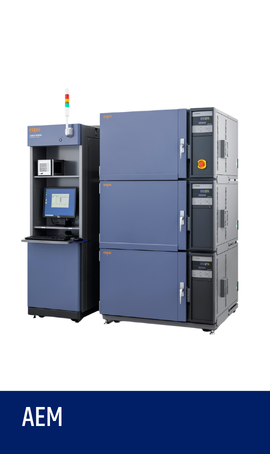
AEM Series + Precision Temperature Control
As current densities increase in shrinking interconnect geometries, electromigration becomes a dominant wear-out mechanism.
The AEM Series evaluates interconnect lifespan by applying controlled current density and elevated temperature conditions to accelerate degradation behavior.
When combined with precision temperature chambers, engineers can:
Model accelerated wear-out mechanisms
Validate interconnect robustness under high thermal load
Support lifespan prediction for microscopic wiring structures
This approach strengthens long-term reliability modeling for advanced node and high-performance device applications.
Environmental & Accelerated Stress Platforms
Electrical measurement systems require stable, repeatable environmental control. Semiconductor reliability is proven under stress — not under nominal conditions.
ESPEC environmental platforms are engineered to replicate mission-critical operating environments while enabling synchronized electrical monitoring.
Temperature Cycling & Rapid Thermal Transition
Operational extremes expose thermal fatigue, material expansion mismatch, and accelerated wear-out mechanisms.
Supported by:
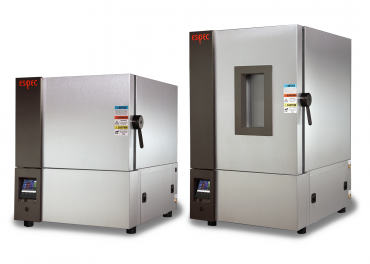
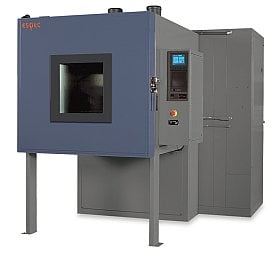
ENA Platinous Series temperature and humidity chambers
Rapid-Rate Thermal Cycle systems
Thermal Shock chambers (TSA / TSD)
These systems align with JEDEC temperature cycling requirements and aggressive transition profiles used for advanced packaging validation.
Humidity & Moisture Stress
Moisture intrusion and electrochemical reactions drive corrosion, insulation degradation, and migration failure.
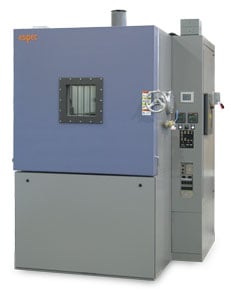
Configurable temperature–pressure environmental systems
These conditions can be simulated where application-specific validation requires pressure or reduced-atmosphere evaluation.
Together, these environmental systems form the foundation of semiconductor reliability testing — enabling engineers to apply controlled stress profiles that mirror real-world operating conditions while capturing electrical behavior in real time.
Flexible & Scalable Solutions for Every Project
Semiconductor development cycles move quickly. Qualification timelines compress. Design iterations accelerate. Your testing infrastructure must keep pace.
ESPEC provides scalable environmental and semiconductor reliability solutions tailored to programs of every size:
Custom environmental configurations to support unique device geometries or specialized test constraints
Integrated electrical and environmental system pairing with engineering guidance
Scalable footprints suited for R&D labs, process development environments, and high-volume production qualification
As device architectures evolve, testing strategies must evolve with them. Our North American engineering and service teams work directly with customers to refine chamber configurations, optimize stress profiles, and ensure repeatable, standards-aligned evaluation.
From early-stage validation to full production screening, ESPEC systems are designed to scale alongside semiconductor innovation.
Application in Practice: Detecting Weak Micro-Via Failures in Advanced Packaging Substrates
As via diameters in advanced semiconductor packaging substrates shrink to 50 μm and below, thermal stress introduces a growing reliability risk: cracking at the base of micro-vias. What makes this failure mode particularly difficult to catch is its behavior under static conditions — weak micro-vias often remain electrically connected when temperature is held constant, masking the defect entirely.
To evaluate this mechanism, a substrate board with a daisy chain configuration (via size: 50–70 μm, double-sided 3-layer structure) was subjected to temperature cycle testing from -55°C to +150°C per JEDEC No. 22-A104E, using an ESPEC TSA thermal shock chamber paired with the AMR-280 Conductor Resistance Evaluation System.
Continuous resistance monitoring during thermal transitions — not just at steady-state intervals — revealed the failure signature: conductor resistance increased precisely during temperature changes, then recovered as conditions stabilized. Without real-time monitoring through the full thermal cycle, this intermittent behavior would have gone undetected.
This is the diagnostic capability that matters in advanced packaging validation. Spot checks and static measurements leave gaps. Continuous, synchronized electrical monitoring during environmental stress closes them.
Why Semiconductor Teams Trust ESPEC
Semiconductor reliability demands precision, repeatability, and technical depth. Over decades of environmental simulation and semiconductor evaluation experience, ESPEC has become a trusted partner to global manufacturers, advanced packaging innovators, and high-performance device developers.
Our customers rely on ESPEC for:
Consistent, repeatable environmental control aligned with global reliability standards
Integrated electrical and environmental system pairing
Engineering-level application support
Long-term service, calibration, and lifecycle support
From early wafer-level validation to advanced packaging qualification and production screening, ESPEC systems are engineered to support measurable, defensible reliability outcomes.
Q: What is the typical lead time for equipment delivery or rental? Lead times vary by system type and configuration. Quick-ship and rental chamber options are available to support urgent qualification or pilot builds. Contact us for current availability and configuration guidance.
Q: Does ESPEC provide compliance support for global semiconductor standards? Yes. ESPEC systems support testing aligned with JEITA, JEDEC, IEC, IPC, automotive, and mission-critical reliability standards. Our engineering teams assist customers in aligning stress profiles and validation procedures with applicable requirements. Schedule a technical consultation to review your compliance objectives.
Q: How is ongoing service and calibration handled? ESPEC provides global service and technical support, including preventive maintenance programs, calibration services, and application guidance to maintain system accuracy and long-term performance. Reach out to coordinate service planning or lifecycle support for your systems.
Q: Can I request a demo or technical consultation? Yes. Technical consultations, system evaluations, and application discussions are available to determine the optimal configuration for your semiconductor reliability program. Request a consultation to begin evaluating your requirements.
Get Started with ESPEC: Request a Consultation
Semiconductor reliability requires more than equipment — it requires a testing strategy built for how devices actually fail. Whether you are qualifying a new design, validating an advanced packaging architecture, or scaling production screening, our engineering team is ready to help you build the right evaluation approach.
Contact us to schedule a technical consultation, request a system configuration, or discuss your qualification requirements.